Monday, April 8, 2024

The Benefits of Fiber-Reinforced Polymer in Power Transmission


Wood, steel, and concrete are commonly used materials for power poles. However, fiber-reinforced polymer (FRP) offers a relatively lightweight, safe, and resilient alternative, which also offers a long service life.

As humans try to move toward “greener” pastures to combat climate change, our power grid is under immense strain. The U.S. grid got its last major overhaul more than 70 years ago, and these now-ancient poles and lines simply cannot step up to the challenge of increasing electrification. A boom in electric vehicles and a surge in 5G build-out ask more of our power infrastructure and utility poles than they can handle, even without the destruction of an increasing number of severe weather events.

Beyond ever-present shortages of funding and labor, grid modernization must face nature’s supply chain problem: trees for high-strength poles. Let’s look at what’s happening with wood first. Then, let’s consider how, as power professionals, we’ve got to expand our toolbox to include composites.
More, Stronger Poles Needed

The modern power grid has to factor in greater live and dead loads that can support our electrification plans and can survive more-severe thunderstorms, hurricanes, wildfires, and more. This means not just more poles but stronger ones.

Table 1 shows the American National Standards Institute’s (ANSI’s) pole class ratings and their traditional suitability. Pole materials are more varied now, but ANSI ratings are based on wood, the only available material for poles originally. But the realities behind this chart are changing.
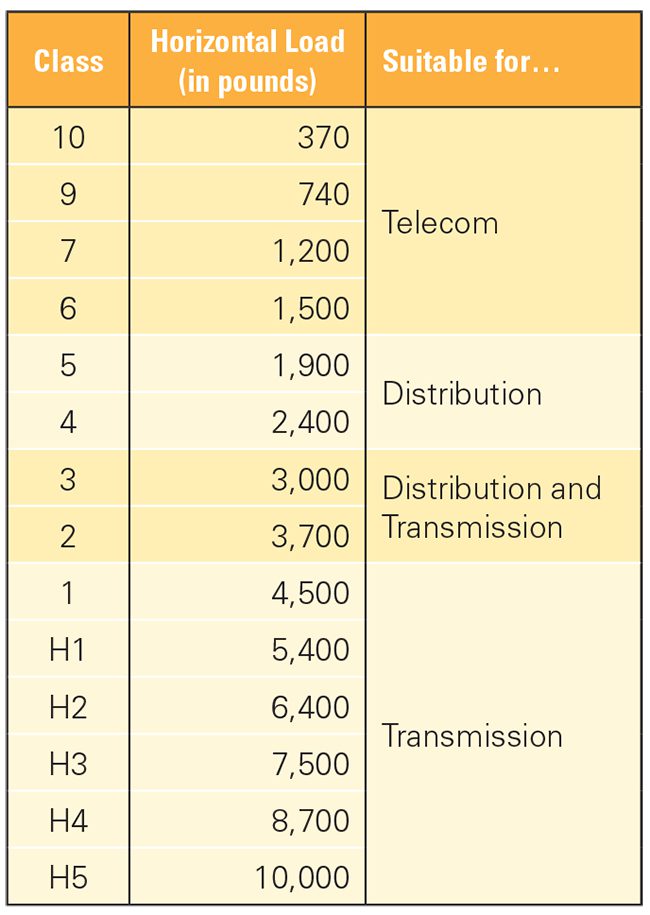

Table 1. The data in this table is taken from the National Wood Pole Standards. Source: Nelson Research

Storms especially have gotten meaner. They hit our power grid with more intensity than traditional Class 5 or 6 poles can handle. The answer has been either to increase the number of lower-class poles or to upgrade to higher-class ones. Even distribution poles can sometimes approach Class 1 or H-class, and transmission poles have mostly moved into the H-classes from Class 1, 2, or 3.

Because of this move to higher classes, a second problem emerges: wood supply. Wood utility poles can come from only certain tree types and heights. Suitable trees make up less than 10% of the average forest. A single tree needs more than a quarter century to grow to usable size, and even then, some will be disqualified for utility use due to size or qualities. And this doesn’t even consider the demand for high-strength, long-length poles for non-utility industries.

This is why, especially for transmission, utilities have largely transitioned to steel. The American Iron and Steel Institute’s 2013 life cycle assessment (LCA) study stood steel and wood up against each other and found steel often outperforms wood on durability and environmental impact. Other utilities have looked to concrete for a solution.

The massive overhaul our grid needs requires that we arm ourselves with as many tools as possible to meet the demand for stronger, safer, more sustainable utility poles. Fiber-reinforced polymer (FRP), a composite, is another available option that is up to the challenge of even power transmission.
FRP Utility Poles: How Do They Compare?

An engineered material consisting of reinforcement fibers, polymer resin, and additives, FRP is both strong and durable. FRP utility poles are pultruded, which yields a constant cross-section, fiber tension, and orientation. The selection guide (Figure 1) shows the equivalent Creative Composites Group FRP poles for different classes and lengths of wood poles.
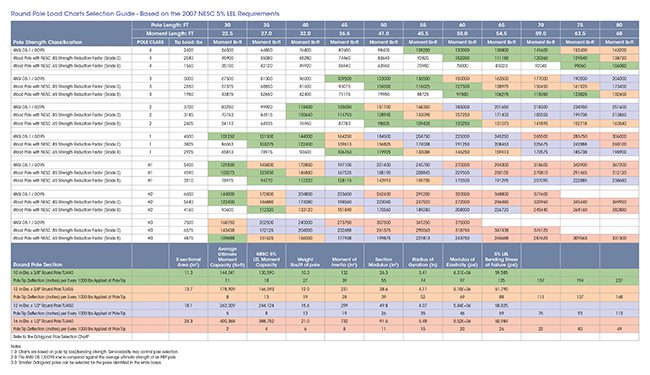

1. To use the chart, locate the desired wood strength classification, class, and length. The color of the box corresponds to the equivalent fiber-reinforced polymer (FRP) pole. For example, if you required a 70-foot Class H2 ANSI 05.1/GO95 pole, the red box indicates the 16-inch diameter TU460 pole as the equivalent. Creative Composites Group is constantly expanding its offerings to meet market needs, which is why an 18-inch pole will soon be available. Courtesy: Creative Composites Group (CCG)

A 40-foot Class 1 wood pole weighs about 1,100 pounds and a similar steel pole weighs 692 pounds. However, an equivalent FRP pole is much lighter than either of those options, weighing 412 pounds. This light weight makes FRP poles a great choice for limited-access areas or for helicopter sets, as more can be transported to the site in fewer loads without sacrificing strength.

Comparing its strength to its weight, FRP has a much greater ratio. As shown in Table 2, the stiffness-to-weight ratio for glass FRP ranks lower than steel, but this can be overcome with cross-section geometry. Other qualities that make FRP poles good for both transmission and distribution are their safety characteristics, resiliency, and long service life.
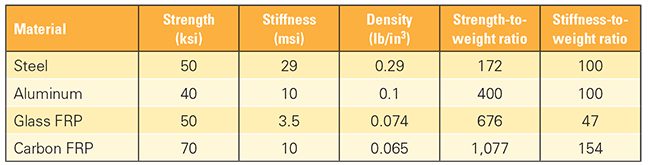

Table 2. This table shows some properties of different types of poles. The information for Glass FRP and Carbon FRP is conservative; the actual material properties of FRP are usually higher. Source: CCG

Safety. Line crew demonstrations have proven that composite poles are light enough to be moved along the ground by a single person and that these poles are field-drillable, unlike concrete and steel. FRP poles aren’t treated with pesticides or chemicals and don’t leach anything harmful into the ground.

Further keeping workers and the grid safe, FRP poles overcome a major drawback of steel poles: conductivity and low dielectric strength. Steel poles offer excellent strength, stiffness, and length of service life, but as a metal, they must be properly insulated to prevent hazards and interruptions or to avoid breakdown from contact with high voltages. FRP has low thermal conductivity and great dielectric strength.

Resiliency. Composite poles are pultruded, meaning the profile is pulled through and exits the die in the desired cross-section or shape. As an engineered material, composite utility poles exhibit a coefficient of variation of less than 5%. Pultruded profiles have a higher tensile strength than conventional steel, and are designed to be somewhat flexible so they can endure a significant load during extreme conditions and yet return to their initial state. This is a significant benefit when compared to steel, which stays bent if stressed past its yield strength, or to wood and concrete, which can snap.

FRP’s impact energy absorption capacity is also the highest among competing materials. As the graph in Figure 2 shows, FRP poles can take on twice the impact energy of wood and, especially important to transmission design engineers, 10 times more than steel. FRP poles also have a good modulus of elasticity and good flexural strength.
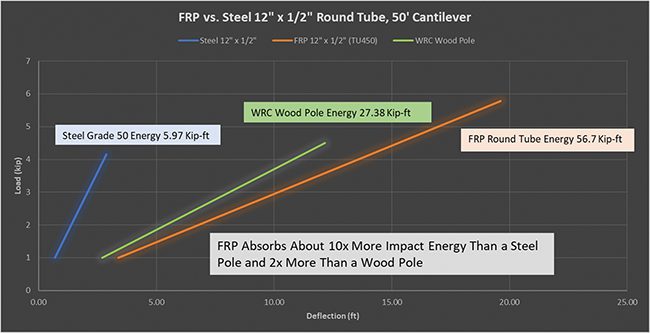

2. This chart compares the impact energy that steel, wood, and FRP poles can withstand. Courtesy: CCG

Service Life. FRP poles are capable of long service lives. FRP is inherently corrosion-resistant because no component of the composite can oxidize. This also makes it inert to a wide variety of bases and acids. And unlike wood and concrete, FRP absorbs a negligible amount of moisture, and it is not susceptible to moisture exposure degradation like steel. Furthermore, composites are unattractive to termites, woodpeckers, squirrels, beavers, and other wildlife that can damage wood poles. To add ultraviolet (UV) protection, FRP receives a nontoxic coating, and for aesthetic or architectural benefits, composite utility poles can be tinted to customer color specifications to better blend in with their surroundings.
Expand the Options for Transmission

Utilities need to consider every available option for power poles as the time—and finally the funding—becomes available to revitalize our decrepit grid. When specifying utility poles, consider composite poles alongside traditional alternatives. The data show that FRP poles have the performance and mechanical characteristics to harden the modern power grid. Composites and their many benefits may be just what your project is looking for.

Creative Composites Group (CCG) is just one manufacturer of pultruded FRP utility poles. The following link will open a large chart titled “StormStrong Round Pole Mechanical and Physical Properties,” which shares data for the four round FRP poles currently offered by CCG.

Saturday, April 6, 2024

Carbon Fiber Market size to increase by USD 2732.91 million between 2022 to 2027, Market Segmentation by End-user and Geography, Technavio


NEW YORK, April 3, 2024 /PRNewswire/ -- The global carbon fiber market size is estimated to grow by USD 2732.91 million from 2023 to 2027, according to Technavio. The market is estimated to grow at a CAGR of almost 7.43% during the forecast period. The carbon fiber market faces challenges due to patents, natural ingredients, and multiple strains. In developing markets like India, price increases could hinder growth. South Africa's market is underpenetrated.


The End-user segment emerges as the fastest-growing segment in the carbon fiber market

The Carbon Fiber Market continues to expand in various industries, including aerospace and defense. Carbon fiber's unique properties, such as high strength-to-weight ratio and excellent chemical resistance, make it a preferred choice for manufacturers. Companies like MBDA, Airbus, and Mercedes-Benz utilize carbon fiber in logistics, missiles, and vehicles, reducing weight and enhancing performance. Precursor chemicals like Polyacrylonitrile undergo a complex process to create Polymer Matrix Composites. Machine manufacturers ensure ISO 9000 standards for customer satisfaction. Startups and holding companies in California and San Francisco innovate, pushing market penetration. Risks, such as pollution and production costs, are mitigated through technological advancements. Carbon fiber is used in rockets, satellites, and jet engines, contributing to the energy crisis solution. Income is generated from the leisure industry, with brands like Ferrari and Volkswagen incorporating carbon fiber in dashboards and vehicle structures. Globalization increases demand, with companies like A&P and ISO 9000 ensuring quality control through email communication. The chemical compound's use in missiles and rockets, as well as in vehicles, continues to drive the market forward.

The Carbon Fiber Market in the US and Canada is driven by industries such as aerospace, automotive, wind energy, and construction. With major players like Airbus, Boeing, and MBDA, the region is a leading exporter. The aerospace sector, including commercial aviation and large jets, dominates the market. CAFE standards in the US push for lighter vehicles, increasing demand. Carbon fiber's use in vehicles from Mercedes-Benz, Volkswagen, and Ferrari reduces pollution. Precursor chemicals like Polyacrylonitrile are used to create Polymer Matrix Composites. Startups and holding companies innovate, with risk taken in the pursuit of market penetration. Rocket and missile manufacturing also contribute. San Francisco's A&P companies use carbon fiber in dashboard production. ISO 9000 certification ensures customer satisfaction. The energy crisis drives the use of carbon fiber in wind energy and satellites. Machine manufacturers ensure efficient production processes. Email communication facilitates globalization. The chemical compound's use in jet engines and lightweight vehicles increases income. Leisure industries also adopt carbon fiber for luxury products.

Commenting on the market trends, a Senior Analyst of Technavio, stated," The carbon fiber market experiences intense competition, with frequent launches of innovative products. In 2022, Nestle, Danone SA, and Dr. Willmar Schwabe introduced new probiotic offerings, boosting market growth. Keywords: Market competition, Probiotics, Nestle, Danone SA, Dr. Willmar Schwabe. Carbon fiber industry also innovates, with new applications in automotive (Mercedes-Benz, Volkswagen), aerospace (Airbus, Boeing), and sports (Ferrari) industries. Keywords: Automotive, Aerospace, Sports industry."


Market Overview

The Carbon Fiber Market is experiencing significant growth, driven by the increasing demand for lightweight and strong materials in various industries. Companies like A, P, and MBDA are major contributors to this market, manufacturing and marketing carbon fiber products. These companies use advanced technologies to produce high-quality carbon fiber, such as polyacrylonitrile (PAN) and pitch-based carbon fiber. The use of carbon fiber is prevalent in the aerospace industry for making aircraft components, as well as in the automotive sector for manufacturing lighter and more fuel-efficient vehicles. Additionally, the chemical industry utilizes carbon fiber in the production of chemicals, while the construction industry employs it for creating stronger and more durable structures. The market for carbon fiber is projected to continue expanding, with a particular focus on the development of cost-effective production methods.

Fiber Awards, Research, Fiber Research, Fiberreinforced Polymer Composites, Fiber Marketing, Nano Composites, sciencefather, Carbon Fiber Composites Materials.

To understand more about this market- Download a FREE Sample Report in minutes!

NREL’s Recyclable Carbon Fiber Composites Made Greener With Thermoforming


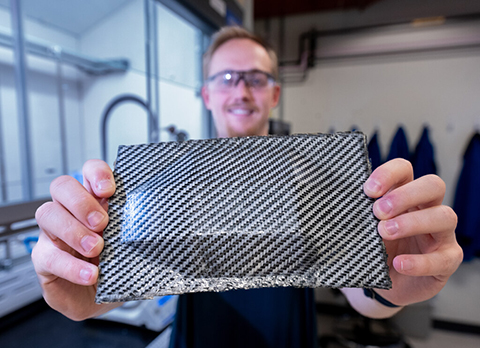
Nicholas Rorrer does not describe himself as a car guy. Even so, new advancements in his research developing recyclable carbon fiber composites using bio-derivable epoxies represent some of the most promising solutions yet for decarbonizing the vehicle manufacturing process and beyond.  

“Vehicles are a real driver, pun intended, of the materials economy. To me, they represent nearly endless opportunities in materials design—not only to make the first generation of a material better but to also improve upon those designs in future generations,” said Rorrer, who is a senior polymer science researcher and group manager at the National Renewable Energy Laboratory (NREL).

Rorrer currently leads a team of NREL researchers working to replace the heavy, resource-intensive steel parts in vehicles with recyclable carbon fiber composites. The ongoing project is supported by the U.S. Department of Energy's Vehicle Technologies Office under the Composites Core Program in the Materials Technology subprogram.

The Key to Earth-Friendly Carbon Fiber Composites

When used in place of steel in vehicle components like hoods and roofs, carbon fiber composites can reduce the weight of a typical passenger car in half—boosting fuel efficiency by up to 35%—without sacrificing strength. This swap can free up weight and space for bigger batteries in electric vehicles, resulting in longer ranges and better energy efficiency.

But the benefits of traditional carbon fiber composites stop there. The material’s manufacturing processes are energy, greenhouse gas (GHG) emissions, and cost intensive, canceling out any environmental benefits.

“Traditional carbon fiber composites cost too much, are too brittle, and have high GHG emissions. Vehicle manufacturers aren’t interested in using them,” Rorrer said. “But transitioning to lighter vehicles using more affordable, strong, and Earth-friendly carbon fiber composites can be an important part of decarbonizing the transportation sector.”

In fact, carbon fiber composites made with NREL’s polymer science and engineering bio-derivable resin can be recycled at least three times. And a recent breakthrough by the NREL team may make their reuse even more cost and energy efficient.

“This is huge,” said NREL’s Erik Rognerud, a research technician on the project. “This technology could finally make carbon fiber affordable for consumer vehicles, which means cars will have better gas mileage or longer driving ranges. Carbon fiber composites will save money at the pump or by charge and reduce carbon dioxide in the environment.”

A More Efficient Recycling Process

NREL’s recyclable carbon fiber composites are made up of bio-derivable epoxies, anhydride hardener, and carbon fibers. Rorrer and his team initially used a multistep process called methanolysis to prove the material’s recyclability. The application of this process represented the material’s first step toward circularity, a model of production and consumption that extends the life cycle of products—making the carbon fiber composites cheaper and greener when used across multiple lives.

In methanolysis, an inexpensive catalyst is added at room temperature to trigger chemical depolymerization, a process that causes the components to separate. Researchers can then reclaim the original carbon filaments for reuse with new bio-derivable epoxies and anhydride hardener.

“With thermoforming, you can skip all of that,” Rorrer explained, referring to the process of separating the material’s components in methanolysis. The impact of this work is detailed in the NREL presentation, Bio-Based, Inherently Recyclable Epoxy Resins to Enable Facile Carbon-Fiber-Reinforced Composites Recycling. “We have shown that you can simply press the material into different shapes to reuse them. And when you use both chemical depolymerization and thermoforming, you can reduce the cost and GHG emissions of the material’s second life by 90% to 95% compared to the first life of the material.”

The NREL team’s thermoforming process saves time and energy by allowing the material to stay intact. In thermoforming, researchers heat the recyclable carbon-fiber-reinforced composite to just above the boiling point of water and press it between two molds to shape the material for its next use.

But Rorrer and his team are not finished improving the material’s recycling process. The team is continuously exploring strategies for making thermoforming even easier, faster, and more energy efficient.

More Advancements Ahead

Rorrer is determined to continue developing NREL’s recyclable carbon fiber composites as a cost-effective, lightweight, and environmentally friendly alternative to steel. Beyond its use in vehicles, the team is studying the material’s performance in applications like wind turbine blades. Future partnerships also present the opportunity to unlock additional applications by considering other manufacturing processes.

“In the first phase of this work, we focused on reducing the environmental impacts of the material’s subsequent lives,” Rorrer said.

In the next phases, the team will look for ways to reduce the environmental impacts and improve the performance of the material’s first life.

“We really want to develop a technology that automobile manufacturers would be excited about using broadly,” he said. “I think the next challenge after this phase of work, or even possibly as a part of this phase of work, is to make sure that our materials can be transformed into prototypical parts through today’s manufacturing requirements.”

Learn more about NREL's sustainable transportation and mobility research and its specific focus on transportation decarbonization. And sign up for NREL's quarterly transportation and mobility research newsletter, Sustainable Mobility Matters, to get the latest news.

  1. Research
  2. Fiber Reseach
  3. FRPConference2024
  4. FiberReinforcedFuture
  5. FRPDesignAndAnalysis
  6. GlobalFRPForum
  7. SmartComposites
  8. FRPIndustryTrends
  9. BuildingWithComposites
  10. InnovateFRP
  11. SustainableComposites
  12. FRPWorldCongress
  13. sciencefather


For more Information about like this https://fiberreinforcedpolymer.com

Why Use Carbon Fiber Reinforced Concrete (CFRC)?


Concrete is the most widely used construction material in the world due to its cost-effectiveness, abundance of raw materials, facile manufacturing, and adequate physical and mechanical properties.


Concrete has limitations, however, which can hinder its durability and useable lifetime. Mainly, its lower flexural and tensile strength and brittleness can cause structures to fail without warning under tensile and shear conditions.

For this reason, structural concrete is commonly reinforced to improve the structural integrity of buildings. Whilst steel fiber is the main reinforcing element used globally, there are some issues with its use, mainly its long-term performance and sustainability.

This article will explore carbon fiber reinforced concrete, an alternative to conventional steel fiber reinforced concrete.
Why Use Carbon Fiber?

Carbon fiber has seen growing use in recent years in the construction industry, mostly in the framework of curtain walls, partition panels, and walls. First explored as a potential construction material in the 1970s, it was demonstrated that carbon fiber reinforced concrete (CFRC) had some suitable properties.

Early studies on CFRC made from PAN fiber significantly improved the impact strength, tensile strength, and elastic modulus of concrete. In 1980, a Japanese study using pitch carbon fiber reported noteworthy improvements using just 0.2% carbon fiber by volume.

Further studies confirmed that even a minuscule fraction of carbon fiber significantly improves the mechanical properties of concrete, and carbon fiber outperforms both steel or glass fiber. This is due to superior durability in adverse conditions, thermal resistance, weatherability, and its finish ability.

One drawback of carbon fiber is its cost, however. This has thus far hindered its large-scale use in structural elements, but researchers have argued that the initial expense is worth it compared to the cost of retrofitting failing structures using conventional steel fiber-reinforced concrete.

Currently, there is a lack of literature on the use of CFRP in construction projects due to its perceived expense, even though its benefits are well-recognized. Furthermore, many studies have concentrated on the use of carbon fibers in mortar composites rather than producing CFRC.
Chemical Composition of Carbon Fiber and Characteristics

Carbon fiber contains over 92 wt% carbon, arranged in parallel crystal structures to the fiber’s long axis. The structure can be either amorphous, partly crystalline, or fully crystalline, depending on the manufacturing process, and can exist as either short or long fibers.

Carbon fibers are classed as high-performance due to their essential characteristics. These include low specific weight, ability to withstand stress during dynamic and quasi-static loading conditions, high thermal conductivity, superior creep resistance, high elastic modulus, non-corrosiveness, and chemical stability.


Furthermore, carbon fibers have excellent aesthetic characteristics, making them attractive for projects that require a good finished product. However, there are some limitations with carbon fiber which can hinder its use.

The fibers tend to oxidize when heated or under alkaline conditions. Also, fibers possess drawbacks such as axial vs. transverse anisotropy and low strain to failure. The main issue that hinders the use of CFRC is carbon fiber’s poor ductility, which is lower than alternatives such as glass, Kevlar, and SiO2.

Selecting carbon fiber for a project requires knowledge of the benefits and drawbacks associated with its use.
Carbon Fiber Grades

Different grades of carbon fiber are available commercially. These include low modulus, intermediate modulus, high modulus, ultra-high modulus, super high tensile, and high tensile grades.
Different Types of Carbon Fiber Used in Construction

There are three main types of carbon fiber used in the construction industry: PAN-based, pitch-based, and rayon-based. PAN stands for polyacrylonitrile, a semicrystalline, synthetic organic polymer resin with the formula CH2CHCN.
Overcoming Cost Limitations

As mentioned previously, the high cost of carbon fiber can be prohibitive. However, the unit cost has gradually been coming down in recent years due to the increasing use of carbon fiber in the automotive, aerospace, construction, and medical industries, to name a few.

The cost of carbon fiber is dependent on the grade needed, as well: the higher the tensile strength, the more expensive the fiber. However, with increasing consumption, the advent of relatively cheap, abundant CFRC in construction projects in the future could be more likely.
Forces Responsible for the Mechanical Properties of CFRC.

Fiber-matrix adhesion is responsible for the mechanical properties of fiber-reinforced concrete, consisting of elements such as chemical bonding, mechanical interlocking, and Van der Waals interactions. Chemical bonding is the strongest interaction and can be further improved using fiber sizing or chemical treatment.

These interactions govern the compressive strength, flexural strength, splitting tensile strength, and workability of CFRC. Several studies over the past few decades have explored the optimal carbon fiber percentage in CFRC, with research demonstrating outperformance compared to conventional fiber-reinforced concrete.
Uses in Construction and Outlook

As mentioned previously, the decreasing cost of carbon fiber has increased the attractiveness of CFRC in the construction industry, piquing the interest of experts. Whereas current applications are largely limited to non-structural elements, this is slowly changing. The use of CFRC is still in its infancy.

Currently, the construction industry uses the cheapest fibers, which are isotropic short fibers with poor mechanical properties. However, increasing the use of high-performance carbon fiber should further reduce its cost for the sector.

Recent studies have shown that the benefits of CFRC could potentially outweigh its cost limitations for use in new builds and as a retrofitting and strengthening material. One of the benefits for new structures and repairs which has been highlighted is the lower structural dead load that can be achieved using carbon fibers due to their low density.

A further benefit that could increase the use of CFRC in building projects is its corrosion and chemical resistance. This would provide significant improvements in terms of durability, decreasing ongoing maintenance costs and extending the useable lifetime of structures.

CFRC has already seen use in structural column and beam repair, smart concrete structures, and in bridge construction. Whilst still a fairly niche material compared to conventional steel-reinforced concrete, CFRC is slowly becoming more commonplace. Furthermore, its green credentials align with current sustainability goals.
Final Thoughts

CFRC is an innovative construction material that provides vast benefits for the construction industry, improving the sustainability of the sector and reducing ongoing maintenance costs for existing structures. However, its use in construction is currently limited.

Due to its superior mechanical properties (albeit with some drawbacks) and the fact that carbon fiber itself is becoming cheaper, CFRC could be one of the answers to key current environmental and economic issues the construction industry is facing. Indeed, already some forward-thinking architects and companies are using it.

For more information about the event https://fiberreinforcedpolymer.com

Friday, April 5, 2024

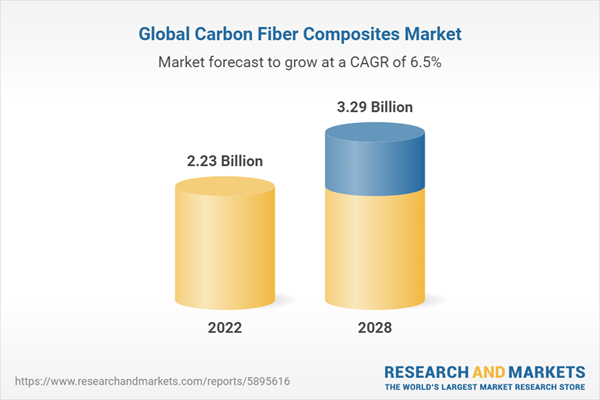
Global Carbon Fiber Composites Market Poised for Robust Growth, Projected to Reach USD 2.23 Billion with a 6.50% CAGR by 2028


Aerospace Industry Fuels Demand
The aerospace sector remains a key driver, where the demand for lightweight and fuel-efficient materials has led to the extensive use of carbon fiber composites. Improved aircraft performance, reduced emissions, and enhanced passenger safety are central to the growing adoption of these materials. Innovations in manufacturing technologies have further solidified the position of carbon fiber composites as essential components in aircraft production.
Automotive Industry's Shift to Lightweight Solutions
Similarly, the automotive industry's shift towards lightweight vehicles to meet stringent emission and fuel economy standards has elevated the role of carbon fiber composites. These materials are integral in the construction of electric vehicles, promoting energy efficiency and battery range, as well as reinforcing safety structures for improved crashworthiness.
Carbon Fiber Composites Rise in Wind Turbine Applications
In the renewable energy domain, particularly wind turbines, carbon fiber composites contribute to the manufacture of longer and more efficient blades, thus supporting the pursuit of green energy. Their durability, strength, and reduced weight have positioned carbon fiber composites as beneficial for enhancing turbine performance and facilitating transport and installation of wind energy infrastructure.
Market Challenges and Regional Insights
However, the market faces challenges such as high production costs and supply chain vulnerabilities. Strategies to manage these could include innovative manufacturing processes and diversified supply sources. Within the regional landscape, Asia Pacific leads the charge, buoyed by increasing vehicle production and sales, while Europe closely follows, bolstered by demand from aerospace and wind energy sectors.
Leading Market Players and Outlook
Key players in the market, such as Toray Industries Inc and SGL Carbon SE, are indicative of an industry landscape that is highly competitive and innovative. Ongoing research and development by these companies ensure that carbon fiber composites continue to meet the evolving needs of diverse industries. Moving forward, the market is set to expand further with manufacturing advancements and a growing emphasis on sustainability poised to drive future growth.
Sectoral Applications and Segmental Insights
According to market segmentation, polymer matrix composites have garnered the largest share, especially within aerospace and defense applications. The market is witness to a diverse range of end uses, from automotive structures to infrastructure reinforcement, reflecting the versatility and pivotal role of carbon fiber composites across industries.
The comprehensive analysis of the global carbon fiber composites market underlines its promising prospects and the strategic role it will play in shaping industrial innovations and contributing to environmental sustainability efforts worldwide.
Key Attributes


Report Attribute Details
No. of Pages 190
Forecast Period 2022 - 2028
Estimated Market Value (USD) in 2022 $2.23 Billion
Forecasted Market Value (USD) by 2028 $3.29 Billion
Compound Annual Growth Rate 6.5%
Regions Covered Global


A selection of companies mentioned in this report includes, but is not limited to:Toray Industries Inc.
SGL Carbon SE
Mitsubishi Chemical Carbon Fiber and Composites, Inc.
Hexcel Corporation
Rock West Composites, Inc.
Teijin Limited
Solvay SA
DowAksa Advanced Composites Holdings BV
Nippon Graphite Fiber Co. Ltd.
Hyosung Advanced Materials

For more information about this report visit https://www.researchandmarkets.com/r/t4ercw

Thursday, April 4, 2024

Are Next-Gen Synthetic Fibers the Future of Sustainable Textiles?

Polyester was once thought to be a wonder fiber. Both durable and efficient, with no need for farmland or vast amounts of water, it threatened to leave natural fibers like cotton in the dust.

It turns out the miracle thread made from oil isn’t so recyclable. But it does break down, bit by bit: in the wash, on land, everywhere. Textiles are a major source of microplastics in the ocean, where they weave their way into the food chain, causing untold harms to marine life. Entire ecosystems are being altered by our clothes. 

Studies tell us we eat and drink its flecks, too, with unknown health impacts, and that the volume of plastic particles in the ocean is doubling about every six years. 

Our daily clothing choices are part of it all, but with polyester, rayon and acrylic so ubiquitous plastic even rains from the sky, choices are limited. Polyester, made from the same plastic as most water bottles, is woven into about half of the world’s clothing. Cheap and easy to make, it’s still the fastest-growing group of fibers used to manufacture garments. 

What’s the solution? Some see the answer to more sustainable fabrics in new materials that can readily decompose or be recycled; others say natural fibers and local supply chains are the way to go. But each approach depends on infrastructure that has yet to be fully realized. If the end game is simply more mass production and consumption, with the thought that all of this material will quickly degrade or find its way to recycling, our oceans and landfills of trash will only grow.

The high cost of fast fashion 

Fast fashion uses both synthetic and natural fibers, and the environmental trade-offs between the two are endless, from land and water use to chemical inputs. But when it comes to planet-heating emissions, fossil fuel-based synthetics—the main materials in use—are clear losers. Fashion contributes around 10 percent of global greenhouse gas emissions, second only to big oil. And most of the carbon footprint of a garment is around producing its fibers. 

Another big factor is end of life. There is nowhere near enough fiber recycling infrastructure in the US, where 85 percent of used clothes and other textiles get sent to the landfill. In California, most clothing is disposed of through curbside solid waste collection—a straight route to the dump. At every level are gaps that prevent “textile circularity” especially when it comes to sorting out salvageable garments and sourcing recycling. And while natural fibers can biodegrade, it’s rarely that simple. Companies often blend natural with plastic fibers, adding dyes and finishes, and blends are particularly hard to recycle because the components require different processes.

For companies, it isn’t profitable to develop large-scale reuse, repair and recycling with the high costs of transportation, labor and processing, along with decreasing quality of new products.

According to standards body Textile Exchange, only about 14 percent of polyester is made from recycled fibers. Companies are working on technology to make it easier—yet thousands of dangerous chemicals are used to make plastic goods and researchers are sounding the alarm about recycling them. 

In addition, most natural fibers are grown conventionally, which often means heavy use of pesticides, synthetic fertilizers and genetically modified or treated seedsCotton, the most used natural fiber, occupies 2.4 percent of the world’s farmland but uses 4.7 percent of the world’s pesticides and 10 percent of its insecticides

Enter next-gen synthetics. A slew of startups is out to replace both polyester and natural fibers with alternatives they say are better for the planet.

https://modernfarmer.com/2024/04/sequestering-carbon-art/

https://modernfarmer.com/2024/03/next-gen-synthetic-fibers/

Wednesday, April 3, 2024

Nylon Market Advancements Highlighted by Sales Report 2022 - 2030

Nylon Market

Nylon, a versatile synthetic polymer, has entrenched itself as a cornerstone in various industries owing to its exceptional strength, durability, and adaptability. The market, valued at USD 22.4 billion in 2021, is forecasted to burgeon to USD 39.1 billion by 2030, spurred by its manifold applications and indispensability across sectors.

Download Sample Report Copy Of This Report From Here: www.amecoresearch.com/sample/276852

Key Points and Statistical Data:

Market Overview and Analysis: Nylon's unparalleled combination of strength, durability, and lightweight properties renders it indispensable across diverse industries. Its utility as a substitute for natural materials underscores its significance, with emerging economies propelling demand for infrastructure, transportation, and consumer products reliant on this versatile polymer.

Latest Market Trends and Innovations:

Major Growth Drivers:

Key Challenges:

To Check Complete Toc Here:

CHAPTER 1. Industry Overview of Nylon Market

CHAPTER 2. Research Approach

CHAPTER 3. Market Dynamics And Competition Analysis

CHAPTER 4. Nylon Market By Type

CHAPTER 5. Nylon Market By Application

CHAPTER 6. North America Nylon Market By Country 

CHAPTER 7. Europe Nylon Market By Country

CHAPTER 8. Asia Pacific Nylon Market By Country

CHAPTER 9. Latin America Nylon Market By Country

CHAPTER 10. Middle East & Africa Nylon Market Overview

CHAPTER 11. Player Analysis Of Nylon Market

CHAPTER 12. Company Profile

Market Segmentation Insights:

Overview by Region of the Nylon Market:

Asia-Pacific, particularly China, is a significant player in the nylon market, with a strong industrial base and large production capacity.

North America, especially the United States, is a key market due to its advanced industrial infrastructure and diverse end-user sectors.

Europe is also a major market, with countries like Germany, France, Italy, and the UK focusing on high-performance nylon applications.

List of Key Players in the Global Nylon Market:

The market includes prominent players such as Honeywell International, Inc., BASF SE, Huntsman Corporation, Evonik Industries AG, E.I. Dupont De Nemours & Company, Asahi Kasei Corporation, UBE Industries Limited, and Invista S.A.R.L.

Report: www.amecoresearch.com/buy/276852  


Dr. Bahiru Bewket Mitikie | Biomimetic and Bio-inspired Composites | Best Academic Researcher Award

 Dr. Bahiru Bewket Mitikie | Biomimetic and Bio-inspired Composites | Best Academic Researcher Award πŸŽ‰πŸ† CONGRATULATIONS TO DR. BAHIRU BEWK...