Saturday, July 20, 2024

Performance of Natural Polymer Composites with Nano-SiO2 Filler


In a study published in Materials Today: Proceedings, the impact of adding nanoscale SiO2 fillers to kenaf fiber polymeric composites on mechanical properties is investigated. The polymers' compressive, tensile, and impact characteristics were examined.

Benefits of Using Natural Fibers

Due to the rising appreciation of the need to utilize legitimate resources to replace those created by conventional materials, natural fiber is increasingly being employed as a support or filler element in fabricating composites.

Natural fibers offer a variety of desirable characteristics, including minimal price, sustainability, good mechanical capabilities due to their lower density, and simplicity of treatment thanks to their non-abrasive nature, which enables higher levels of packaging.

Furthermore, natural fibers have grown in favor as a reinforcement element over the past few decades due to their environmentally friendly and limitless properties, lightweight nature, and ease of production.

Artificial polymer composites are difficult to dispose of, and the use of plastic has been restricted in multiple countries. As a consequence, the need for natural fibers has increased across a wide range of businesses.

Reduced Mechanical Strength

Natural fibers are usually made of lignocellulose biomass and possess a high moisture absorption capability, making them appropriate for a wide range of interior purposes such as furnishings, seismic attenuations, packing.

Nonetheless, in terms of mechanical strength, organic fibers still lag behind synthetic fibers significantly.

To achieve the same strength as synthetic fibers, they must undergo a range of chemical processes, hybridizing by using organic and synthetic fibers and interweaving them into many configurations.

Furthermore, the limitations of using reinforcement organic fiber filler elements include their poor adhesion to the matrix due to the fiber's hydrophilic nature and the matrix's murky nature. Consequently, a sub-par fiber-matrix connection is formed, decreasing the strength effect of the fiber and inhibiting force transfer between fibers and matrix material.

The quantity of binding between the polymeric composite matrix and the fibers determines the properties of natural fiber polymer matrix composites.

How to Address this Shortcoming

Historically, chemical approaches have been employed to modify the properties of fibers. Solvents that are organic in nature, such as alkali-based compounds, silane, peroxides, isocyanates, as well as polymer coupling agents, are widely used.

Another method for enhancing the properties of natural fiber reinforced composites is to include particle or powder form filler elements into matrices.

The appropriate combination of matrix elements, fillers, and reinforcement materials may produce a composite with equivalent or even greater properties than typical composite alloys.

In commercial and industrial applications, the use of particle filler materials with polymers is becoming increasingly common.

Fillers are added to polymers to improve their process capability, stiffness, and durability. To address polymer restrictions such as weak stiffness and to utilize them in a variety of applications, synthetic fillers such as silica, alumina, carbon, titania, and fly ash particles in the form of nanoscale particles are routinely used in combination with matrices for forming polymeric nanocomposites.

It is feasible to improve the properties of natural/synthetic fiber composite materials by modifying the matrix using nano-SiO2 filler.

This work aims to experimentally explore the tensile and compressive strength of kenaf fiber reinforced epoxy composite at varied levels of nano-SiO2 filler loading.

A compression molding machine was used to make the composite plates.

Important Findings of the Study

The impact of disbanding nano-SiO2 fillers on the mechanical properties of kenaf fiber epoxy composite was examined by the research team.

In composite, the mass fraction of nano-filler was selected to be 0%, 1%, 2%, 3%, and 4%.

The highest tensile strength of the composite was found with 2% nanofiller, which was substantially greater than that of the regular composite.

Similarly, nano-SiO2 fillers at 2% mass in composites improved compressive and impact strengths. Overall, the 2 percent fraction of nano-SiO2 filler was shown to be the optimal content in the kenaf fiber epoxy composite.

Visit Our Website: fiberreinforcedpolymer.com Contact us: contact@fiberreinforcedpolymer.com Award Nomination Link: https://x-i.me/sudnom1 Member Nomination Link: https://x-i.me/fibermem Get Connected Here: ================== Twitter : https://twitter.com/MeghnaAgar51453 Blog : https://fiberreinforced2.blogspot.com/ Instagram: https://www.instagram.com/meghnaagarwal12/ Pinterest: https://in.pinterest.com/FiberreinforcedPolymer/ #fiberreinforcedpolymer#compositematerials #advancedmaterials #polymercomposites #hybridcomposites #materialscience #epoxyresin #PolyesterResin #EngineeringMaterials #HighPerformanceComposites #MaterialInnovation #ProstheticsTechnology #LightweightMaterials #MechanicalProperties #CompositeEngineering#researcher #doctor #lecture #scientists


Friday, July 19, 2024

Optical fiber


An optical fiber, or optical fibre, is a flexible glass or plastic fiber that can transmit light from one end to the other. Such fibers find wide usage in fiber-optic communications, where they permit transmission over longer distances and at higher bandwidths (data transfer rates) than electrical cables. Fibers are used instead of metal wires because signals travel along them with less loss and are immune to electromagnetic interference. Fibers are also used for illumination and imaging, and are often wrapped in bundles so they may be used to carry light into, or images out of confined spaces, as in the case of a fiberscope. Specially designed fibers are also used for a variety of other applications, such as fiber optic sensors and fiber lasers.

Glass optical fibers are typically made by drawing, while plastic fibers can be made either by drawing or by extrusion. Optical fibers typically include a core surrounded by a transparent cladding material with a lower index of refraction. Light is kept in the core by the phenomenon of total internal reflection which causes the fiber to act as a waveguide. Fibers that support many propagation paths or transverse modes are called multi-mode fibers, while those that support a single mode are called single-mode fibers (SMF). Multi-mode fibers generally have a wider core diameter and are used for short-distance communication links and for applications where high power must be transmitted. Single-mode fibers are used for most communication links longer than 1,050 meters (3,440 ft).

Being able to join optical fibers with low loss is important in fiber optic communication. This is more complex than joining electrical wire or cable and involves careful cleaving of the fibers, precise alignment of the fiber cores, and the coupling of these aligned cores. For applications that demand a permanent connection a fusion splice is common. In this technique, an electric arc is used to melt the ends of the fibers together. Another common technique is a mechanical splice, where the ends of the fibers are held in contact by mechanical force. Temporary or semi-permanent connections are made by means of specialized optical fiber connectors.

The field of applied science and engineering concerned with the design and application of optical fibers is known as fiber optics.

Visit Our Website: fiberreinforcedpolymer.com Contact us: contact@fiberreinforcedpolymer.com Award Nomination Link: https://x-i.me/sudnom1 Member Nomination Link: https://x-i.me/fibermem Get Connected Here: ================== Twitter : https://twitter.com/MeghnaAgar51453 Blog : https://fiberreinforced2.blogspot.com/ Instagram: https://www.instagram.com/meghnaagarwal12/ Pinterest: https://in.pinterest.com/FiberreinforcedPolymer/ #fiberreinforcedpolymer#CompositeMaterials#AdvancedMaterials#PolymerComposites #HybridComposites#MaterialScience#EpoxyResin#PolyesterResin#EngineeringMaterials #HighPerformanceComposites#MaterialInnovation#ProstheticsTechnology#LightweightMaterials #MechanicalProperties#CompositeEngineering#researcher#doctor#lecturer#scientists
#sciencefather#fiberlaser#fiberoptics

Tuesday, July 16, 2024


The global Fibre-reinforced polymer (FRP) Pipe Market size was valued at USD 4402.9 million in 2022 and is forecast to a readjusted size of USD 6345.2 million by 2029 with a CAGR of 5.4% during review period.


Market Overview:

The Fibre-reinforced Polymer (FRP) Pipe Market is witnessing substantial growth, driven by the increasing demand for lightweight, corrosion-resistant, and durable piping solutions across various industries such as oil and gas, water and wastewater, chemicals, and infrastructure. FRP pipes, composed of reinforcing fibres embedded in a polymer matrix, offer superior mechanical properties, chemical resistance, and long-term performance compared to traditional materials such as steel, concrete, and PVC.

Market Key Players:

Leading companies in the Fibre-reinforced Polymer (FRP) Pipe Market include:
• Future Pipe Industries (FPI)
• National Oilwell Varco (NOV)
• AMIBLU
• Farassan
• Fibrex
• Lianyungang Zhongfu
• Hengrun Group
• Abu Dhabi Pipe Factory
• Shawcor (ZCL Composites Inc)
• Enduro Composites
• Chemical Process Piping (CPP)
• Graphite India Limited


These key players specialize in the design, manufacturing, and distribution of FRP Pipes, fittings, and accessories, catering to diverse customer requirements and industry applications. Their focus on product innovation, quality assurance, and customer service drives market competitiveness and industry advancement.

Market Segmentation by Type:
• Polyester
• Epoxy
• Other

Market Segmentation by Application:
• Oil and Gas
• Municipal
• Agricultural Irrigation
• Industrial
• Other Applications

Regional Markets:

US Market:

The United States is a major market for Fibre-reinforced Polymer (FRP) Pipes, driven by factors such as infrastructure development, aging pipeline replacement, and increasing environmental regulations. The country's oil and gas industry, in particular, has been a significant adopter of FRP pipes for offshore and onshore applications, including drilling, production, and transportation. Market players in the US focus on product differentiation, customer support, and regulatory compliance to maintain market leadership and meet industry requirements.

EUROPE Market:

Europe is another key region in the Fibre-reinforced Polymer (FRP) Pipe Market, characterized by its stringent environmental regulations, water conservation initiatives, and infrastructure modernization projects. Countries such as Germany, the United Kingdom, and France are leading consumers of FRP pipes in applications such as water distribution, sewer systems, and industrial facilities. Market players in Europe emphasize sustainable manufacturing practices, product quality, and performance testing to meet market expectations and regulatory standards.

APAC Market:

The Asia-Pacific region is experiencing rapid growth in the Fibre-reinforced Polymer (FRP) Pipe Market, driven by factors such as urbanization, industrialization, and increasing investments in water and wastewater infrastructure. Countries such as China, India, and Japan are key contributors to market growth, with a focus on large-scale infrastructure projects, including water supply networks, desalination plants, and industrial facilities. Market players in APAC leverage local partnerships, market insights, and technology transfer to capitalize on regional opportunities and expand market presence.

Market Segmentation by Regions:

• North America (United States, Canada and Mexico)
• Europe (Germany, France, United Kingdom, Russia, Italy, and Rest of Europe)
• Asia-Pacific (China, Japan, Korea, India, Southeast Asia, and Australia)
• South America (Brazil, Argentina, Colombia, and Rest of South America)
• Middle East & Africa (Saudi Arabia, UAE, Egypt, South Africa, and Rest of Middle East & Africa)

Market Strengths, Weaknesses, Opportunities, and Threats (SWOT)

Market Strengths:

The Fibre-reinforced Polymer (FRP) Pipe Market offers several strengths, including superior corrosion resistance, high strength-to-weight ratio, and low life-cycle costs. FRP pipes are lightweight, easy to install, and require minimal maintenance, making them suitable for a wide range of applications across industries. Additionally, FRP pipes offer design flexibility, allowing for customized solutions and optimized performance characteristics.

Market Weaknesses:

Despite their many advantages, Fibre-reinforced Polymer (FRP) Pipes face challenges such as higher initial costs, limited material options, and complex manufacturing processes. Market players need to address these weaknesses through cost optimization, material development, and process innovation to enhance market competitiveness and address customer needs effectively.

Market Opportunities:

The Fibre-reinforced Polymer (FRP) Pipe Market presents significant opportunities for growth and innovation, driven by factors such as increasing infrastructure investments, water scarcity concerns, and technological advancements. Market players can capitalize on these opportunities by expanding product portfolios, targeting niche applications, and offering value-added services such as installation, maintenance, and training.

Market Threats:

Market players need to be vigilant of potential threats such as regulatory changes, supply chain disruptions, and competition from alternative materials. Additionally, economic uncertainties, geopolitical tensions, and environmental challenges could impact market growth and investment decisions, highlighting the need for strategic planning and risk management.

Market Past Performance:

The Fibre-reinforced Polymer (FRP) Pipe Market has demonstrated robust growth in recent years, driven by increasing demand from key end-use industries and technological advancements in material science and manufacturing processes. Market players have achieved significant milestones in terms of product innovation, market expansion, and customer satisfaction, reflecting the market's resilience and potential for further growth.

Market Forecast:

The Fibre-reinforced Polymer (FRP) Pipe Market is poised for continued growth in the coming years, supported by factors such as urbanization, infrastructure development, and environmental sustainability initiatives. Market players are expected to invest in research and development, market expansion, and strategic partnerships to capitalize on emerging trends and market opportunities.

Market Research and Development:

Research and development play a critical role in driving innovation and competitiveness in the Fibre-reinforced Polymer (FRP) Pipe Market. Market players invest in R&D to develop new materials, improve manufacturing processes, and enhance product performance, addressing market needs and industry challenges. Collaborations with academic institutions, research organizations, and industry partners facilitate knowledge exchange, technology transfer, and the development of next-generation FRP solutions.

About Quants and Trends:

Quants and Trends is brand of Ventura Research Pvt. Ltd. Through our consulting research solutions, we guide our clients in discovering answers to their research needs. We pledge to offer our clients only the best research and consulting services. With our low-cost market research services, we assist our clients in understanding the major industry trends, spotting opportunities, and coming to wise conclusions. We understand not every client's particular research needs may be satisfied by syndicated papers. We offer our dear clients with an array of options to tailor research to meet their unique objectives and financial constraints.

#fiberreinforcedpolymer#fiberawards#compositematerials#frp#fiberinternet#fiberlaser#frpresearch#frpinnovation#fibertechnology#researchawards#sciencefather#frpinnovation#frptechnology#compositematerials#university#fiberresearch#frpresearch#fiberlaser#fibertextile#sciencefather#researcher#doctor#professor#scholar#scientist#Professor, #Lecturer, #Scientist, #Scholar, #Researcher, #Analyst, #Engineer, #Technician

Visit Our Website: fiberreinforcedpolymer.com Contact us: contact@fiberreinforcedpolymer.com Award Nomination Link: https://x-i.me/sudnom1 Member Nomination Link: https://x-i.me/fibermem Get Connected Here: ================== Twitter : https://twitter.com/MeghnaAgar51453 Blog : https://fiberreinforced2.blogspot.com/ Instagram: https://www.instagram.com/meghnaagarwal12/ Pinterest: https://in.pinterest.com/FiberreinforcedPolymer/

Wednesday, July 10, 2024

FRP Reinforcement of Masonry Buildings in the Republic of China

If we look further into the long term, considering the long-term benefits, FRP has good durability and hardly needs maintenance in the later period, while other reinforcement methods require higher long-term maintenance costs. Therefore, considering comprehensively, FRP reinforcement method appears to be more economical.


There are a large number of masonry buildings in the ancient city of Nanjing. There are more than 200 masonry buildings in the period of the Republic of China alone. They are an important part of the architectural cultural relics of Nanjing and have important cultural relics, usage and scientific research values.


After nearly a century of baptism, these buildings in the Republic of China are gradually aging and denuding. The wanton transformation of the structure by the owner and the user also caused great damage to these buildings. In addition, at that time, the building structure did not consider the seismic fortification requirements, the seismic capacity of the structure can not basically meet the requirements of the current seismic design code.


In order to better protect and rationally develop these representative excellent buildings and leave rich architectural and cultural heritage for future generations, it is necessary to reinforce masonry buildings in the Republic of China.


In recent years, the Housing Administration Department of Jiangsu Provincial Authority has entrusted testing units to conduct a comprehensive monitoring of the National Heritage Buildings in the Presidential Palace of Nanjing, and is prepared to adopt effective plans for seismic reinforcement of the Presidential Palace based on the test results. The safety evaluation and seismic performance appraisal of the Presidential Palace complex were carried out by the testing unit. The following problems were found:


(1) The material performance of masonry structure is seriously deteriorated, and the compressive bearing capacity of most buildings, especially the first floor walls, can not meet the requirements.


(2) The mortar is basically denuded, and the strength of the remaining mortar is close to zero.


(3) The structure lacks the necessary anti-seismic measures;


(4) Many building stories exceed the current specifications, and the height-thickness ratio basically does not meet the requirements of the Code for Masonry Structural Design (GB 50003-2011). The conclusion is that the seismic performance of the buildings in the Presidential Palace of the Republic of China is very poor, so it is urgent to reinforce them.


Traditional masonry reinforcement methods generally have the following kinds: enlarged section method, enclosed steel reinforcement method, reinforced concrete mortar reinforcement method, external post-tensioned prestressing reinforcement method, cement grouting method and shotcrete reinforcement method. These methods have certain advantages despite a long period of practical engineering application. However, cultural relic buildings are different from general industrial and civil buildings, and have their own characteristics and particularities.


Excellent cultural relics buildings are required to maintain the original style of the building, not to change the superstructure, or even to modify the original facade, in order to avoid destroying the original style, the traditional reinforcement methods can not basically meet these harsh requirements. In recent years, the increasingly mature FRP (Fiber Reinforced Plastics, Fiber Reinforced Plastics, Fiber Reinforced Plastics), mainly composed of high-performance fibers, polyester or epoxy resins, the common materials are mainly carbon fibers, glass fibers and aramid fibers) reinforced masonry method has gradually entered the public's vision. The technology of FRP strengthening masonry structure has been paid more and more attention in recent years because it is suitable for the reinforcement of local cracks in the wall and the reinforcement of the wall under the condition of insufficient bearing capacity. Although there is still a gap compared with Japan, the United States and other advanced countries, but the technology in China still has a very large space for development.


Compared with traditional reinforcement methods, this new technology has unique advantages:


(1) High strength and high efficiency: can greatly improve the ductility and bearing capacity of components, improve the mechanical performance of components. The tensile strength of FRP material is about 10 times of that of steel, but its specific gravity is only 1/4 of that of steel.


(2) Good corrosion resistance and durability: It can make the reinforced components resist the corrosion of various acids, alkalis and salts, and improve the overall durability of buildings. It does not need regular maintenance after reinforcement, and it can protect the internal structure. It has enough ability to adapt to the change of temperature. Adding fire retardant coatings to FRP can also effectively prevent fire, enhance the adaptability of the structure to harsh external environment, and prolong the service life of the structure.


(3) Fatigue resistance: For structures that are often subjected to dynamic, cyclic and variable loads, strengthening can effectively ensure the overall fatigue resistance of the structure.


(4) Maintaining appearance: For various structural shapes such as circular, rectangular and irregular surfaces, joints, beams, slabs, columns and other structural parts, FRP material reinforcement can basically maintain the original appearance and shape of the structure, this advantage has absolutely irreplaceable significance for ancient cultural relics buildings. At the same time, because of the lightweight nature of FRP material itself, the weight gain per square meter after reinforcement generally does not exceed one kilogram, which basically can be considered as not changing the self-weight of the original structure, thus effectively guaranteeing that the seismic performance of the original structure will not be weakened by increasing the self-weight.


(5) Convenient construction: When FRP sheets are used on site, they can be cut arbitrarily according to the specific conditions and needs, without the need to prepare complex construction tools. Therefore, FRP reinforcement construction process has the advantages of short period, high efficiency and less land occupation. According to some data, FRP bonding is 4 to 8 times more effective than steel plate bonding. In addition, because FRP cloth is a flexible material, it can basically achieve 100% effective sticking rate. Even if there are bubbles in the local area, it is very easy to handle. The corresponding acceptance standard is to require 70% effective sticking rate, so it can effectively ensure the quality of construction and acceptance.


(6) The comprehensive economic benefit is good. Although FRP sheet is expensive, it consumes less materials, takes less construction time, does not need large-scale machinery, and the one-time investment cost may not exceed the traditional reinforcement method. If we look further into the long term, considering the long-term benefits, FRP has good durability and hardly needs maintenance in the later period, while other reinforcement methods require higher long-term maintenance costs. Therefore, considering comprehensively, FRP reinforcement method appears to be more economical.


Keywords:
Fiber-reinforced Polymer (FRP)
Composite materials
Polymer matrix
High-strength fibers
Lightweight
Strength
Durability
Structural applications
Engineering
Materials science
Civil infrastructure
Aerospace
Automotive
Manufacturing techniques
Processing methods

#fiberreinforcedpolymer#fiberawards#compositematerials#frp#fiberinternet#fiberlaser#frpresearch#frpinnovation#fibertechnology#researchawards #sciencefather#frpinnovation#frptechnology#compositematerials #university#fiberresearch#frpresearch#fiberlaser#fibertextile#sciencefather#researcher#doctor#professor
#scholar#scientist#researcher#phdstudent#fiberconcrete#Professor, #Lecturer, #Scientist, #Scholar, #Researcher, #Analyst, #Engineer, #Technician, #Coordinator, #Specialist, #Writer, #Assistant, #Associate, #Biologist, #Chemist, #Physicist, #Statistician, #DataScientist, #Consultant, #Coordinator, #ResearchScientist, #SeniorScientist, #JuniorScientist, #PostdoctoralResearcher, #LabTechnician, #ResearchCoordinator, #PrincipalInvestigator, 


Monday, June 24, 2024

New Composite Bridge in Tennessee Showcases Sustainable Solution for Aging Infrastructure


But a new, high-tech bridge in north central Tennessee is equipped with a fiber-reinforced polymer (FRP) composite material bridge deck embedded with fiber optic sensors. It replaced a damaged, decades-old concrete crossing which, like thousands of rural, low-volume bridges across the state and nation, was rated structurally deficient and outdated.

According to the American Society of Civil Engineers, about 8 percent of the more than 617,000 bridges in the U.S. are structurally deficient and need repair. FRP composites offer a low-cost, low-maintenance option and the new structure in rural Tennessee and is intended to demonstrate the benefits of composite materials for rural bridge work.

"This composite bridge has already made a positive impact on Morgan County," said Morgan County Highway Superintendent Joe Miller, who added county officials were looking for a low-maintenance bridge that could be installed fast and at a lower cost than traditional methods. "We have numerous bridges within the county and hundreds across the state that are in need of repair and could benefit from this technology."

For Morgan County, the lightweight, easy-to-install bridge comes at no cost, courtesy of the composites industry. Working together under the umbrella of the Institute for Advanced Composites Manufacturing Innovation, or IACMI—The Composites Institute®, almost a dozen private companies led by Tennessee-based Composite Applications Group (CAG) partnered with industry organizations and university researchers to make the composite bridge a reality.

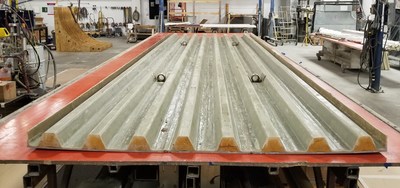
Developed by Structural Composites Inc. (SCI), the 16-feet-long and 25-feet-wide bridge deck is engineered for high-strength and is 90 percent lighter than concrete. It has two 8-by-25-foot corrosion resistant FRP deck panels that were fabricated off-site in a controlled environment.

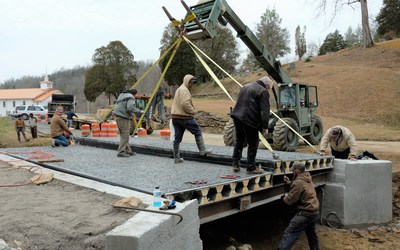
Because the completed bridge sections were so lightweight, they could be transported to the bridge site and installed in one day using a forklift, reducing installation time and energy costs by requiring less construction equipment for on-site preparation.

IACMI Technology Manager John Unser, who is also vice president of program and project management for CAG, said composites have been used for bridge deck applications for more than 20 years and have exceeded all performance and safety standards set by the American Association of State Highway and Transportation Officials (AASHTO). But when it comes to composite bridge decking, he said, many transportation departments across the country, especially those from smaller jurisdictions, are not familiar with the technology.

IACMI and its industry partners are developing a comprehensive case study based on the Morgan County bridge project, including comparing total costs of a typical concrete bridge and one using an FRP bridge deck. Unser said the results will be shared with federal, state and local officials, transportation departments and the civil engineering community so FRP composites will be more a "known" to them.

University of Tennessee, Knoxville (UTK) researchers and engineering students from the Fibers and Composites Manufacturing Facility are part of the bridge partnership. They embedded smart fiber optic sensors developed by Luna Innovations into the bridge surface during production. These high-density sensors are being used to monitor the composite deck system over time to give critical performance and safety data, thus providing a sustainable solution for aging infrastructures such as bridges. In addition, wireless technology developed at UT is being utilized for monitoring the response of the bridge system and traffic counts remotely via cloud computing.

"Lack of durability data is one of the major barriers of the adoption of novel and advance materials including carbon, basalt, or glass fiber reinforced polymeric composites in civil infrastructure," said Dayakar Penumadu, the Fred N. Peebles Professor in the Tickle College of Engineering at UT and Characterization Fellow for Materials and Processing for IACMI.

Penumadu added, "this is a major obstacle for integrating new materials and structures quickly and thus require successful demonstration as being done through this IACMI project. Bridge decks are the most damage prone elements, and we are integrating smart sensors distributed throughout the composite bridge deck that will provide us valuable performance data with time for years to come."

To learn more about the Morgan County bridge project and how FRP bridges offer a sustainable solution to the nation's crumbling infrastructure, visit www.compositebridge.org.

Collaborative Partnership

Led by IACMI, CAG, and the University of Tennessee, Knoxville, a collaboration of private companies contributed expertise and materials such as adhesives, epoxies, coatings and resins, preforms and reinforcements to the Morgan County bridge project. These include SCI, McKinney Excavating Inc., Luna Innovations, Steffen Structural Engineering, Neel-Schaffer Inc., Interplastic Corporation, Engineered Bonding Solutions LLC, West System, Superior Fiberglass, METYX Composites and Compsys, Inc.

About IACMI – The Composites Institute

The Institute for Advanced Composites Manufacturing Innovation (IACMI), managed by the Collaborative Composite Solutions Corporation (CCS), is a partnership of industry, universities, national laboratories, and federal, state and local governments working together to benefit the nation's energy and economic security by sharing existing resources and co-investing to accelerate innovative research and development in the advanced composites field. CCS is a not-for-profit organization established by The University of Tennessee Research Foundation. The national Manufacturing USA institute is supported by a $70 million commitment from the U.S. Department of Energy's Advanced Manufacturing Office, and over $180 million committed from IACMI's partners. Learn more at IACMI.org. Follow @IACMIhq on Twitter, or LinkedIn, or @IACMI on Facebook.

Two 8x25 feet composite bridge decks were manufactured offsite in a controlled environment, transported to the construction site in north central Tennessee, and installed in one day using a forklift.

Developed by Structural Composites Inc., the composite bridge deck is comprised of two 8-by-25 foot fiber-reinforced polymer (FRP) deck panels that are engineered for high-strength, corrosion resistant and 90 percent lighter than concrete.

View original content to download multimedia:http://www.prnewswire.com/news-releases/new-composite-bridge-in-tennessee-showcases-sustainable-solution-for-aging-infrastructure-301264237.html

#fiberreinforcedpolymer#fiberreinforcedcomposite#polymer#fiberreinforcedconcrete#sciencefather#sciencefiction#scientists#frpinnovation#fiberawards#sciencefather#FRP#CompositeMaterials#PolymerMatrix#HighStrengthFibers#Lightweight#StrengthAndDurability#StructuralApplications#EngineeringInnovation#MaterialsScience#fiberglass#CivilInfrastructure#AerospaceTechnology#AutomotiveIndustry#ManufacturingTechniques#FiberArchitecture#FunctionalComposites#SmartMaterials#SustainabilityMatters#environmentalimpact


Shaping the Future of Fiber Technology | Functional & Smart Innovations in FRP

  Explore the latest research shaping the future of fiber technology in “Shaping the Future of Fiber Technology: Exploring Functional and Sm...